
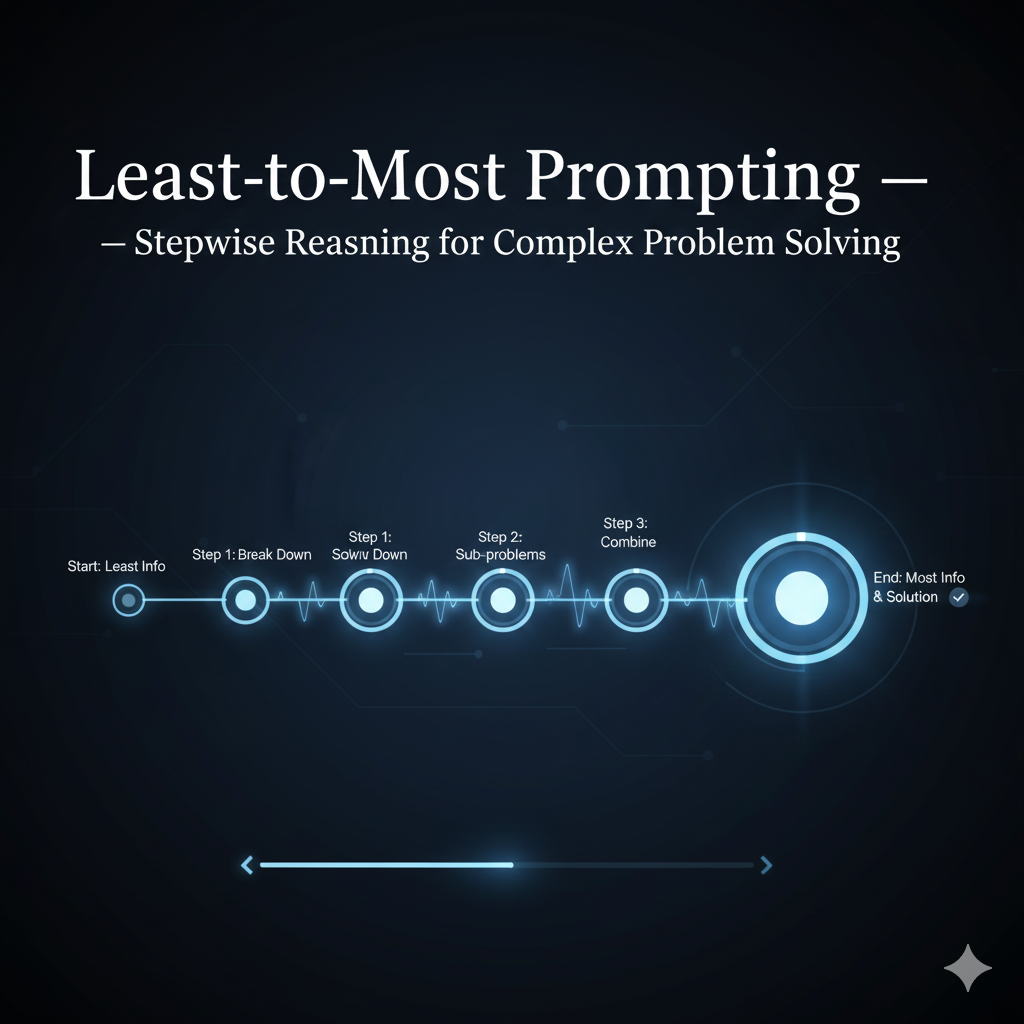
🌳 Least-to-Most Prompting (LtM)
A Practical Developer Guide for Structuring Complex AI Reasoning
Quick Summary: Least-to-Most (LtM) prompting helps LLMs solve complex tasks by breaking them into the smallest subproblems → solving each sequentially → assembling a final answer. This improves generalization, correctness, and debuggability in production systems. 📈 Research shows LtM outperforms normal chain-of-thought on compositional tasks.
Editor's Note: You can safely test the techniques in this guide using the PROMPT_ENGINE AI Prompt Generator. It is fully client-side and secure—your prompts never leave your browser and are never stored or used for AI training.
🧠 1. What is Least-to-Most Prompting?
Least-to-Most consists of two core phases:
-
🪄 Decomposition Convert a hard problem into an ordered list of easier subproblems.
-
🔗 Sequential Solving Solve each subproblem in order, feeding earlier answers into later ones.
This “easy→hard” structure mirrors cognitive scaffolding — start simple, stack gradually.
🚀 2. Why Developers Should Use It
✔️ Stronger Generalization
LLMs can solve problems more difficult than any examples used in prompts.
✔️ Reliability & Observability
Intermediate steps (subproblems + answers) act as debuggable artifacts.
✔️ Lower Cost
Use small models for decomposition, stronger ones only for final assembly.
✔️ Great for MLOps
Logs, tokens, errors per subproblem — perfect for monitoring solution drift.
🔍 3. When to Use LtM (vs CoT/ToT)
| Situation | Use |
|---|---|
| Problem can be broken into clear steps | LtM |
| Simple reasoning chain | CoT |
| Need branching or exploring alternatives | Tree/Graph-of-Thought |
| Need determinism, modular verification | LtM |
Perfect for:
- Math word problems
- Symbolic reasoning
- Multi-step planning
- Code generation with validation
- Data transformation workflows
🧩 4. LtM Workflow (Step-by-Step)
Step 1 — Decompose
Ask the LLM to output structured, ordered subproblems.
Step 2 — Solve Sequentially
Provide each subproblem + any previous answers.
Step 3 — Verify
Check correctness using rules, tests, or constraints.
Step 4 — Assemble
Combine subanswers into a final structured output.
Step 5 — Fix if Needed
Retry only the failing subproblem → avoids recomputing everything.
✍️ 5. Copy-Paste Prompt Templates (Safe • No Testing Required)
🪄 Decomposition Prompt
SYSTEM: You decompose complex problems into small, ordered subtasks.
USER: Problem: <PROBLEM>
INSTRUCTION: Return a JSON array of minimal subproblems to solve sequentially.
🔧 Subproblem Solver
SYSTEM: You solve one subproblem at a time with precision.
USER:
  Problem: <PROBLEM>
  Subproblem: <si>
  Previous answers: <a1..a(i-1)>
INSTRUCTION: Output {"answer": "...", "note": "..."}.
🧪 Verifier + Assembler
SYSTEM: You integrate subanswers and verify correctness.
USER:
  Problem: <PROBLEM>
  Subanswers: <ANSWERS>
INSTRUCTION: Provide the final answer + a list of checks with pass/fail.
🧱 6. Practical Example (Text-Only)
Problem: “A box has 3 red and 2 blue marbles. Add 4 red, remove 1 blue. New counts?”
1️⃣ Decomposition
["count initial reds","count initial blues","apply changes","compute totals"]
2️⃣ Solved Subproblems
a1 = 3a2 = 2a3 = reds=7, blues=1a4 = total=8
3️⃣ Final Answer
✔️ Reds: 7 ✔️ Blues: 1 ✔️ Total: 8
🧰 7. Engineering Tips (for MLEs & MLOps)
🔥 Production Guidelines
- Log every subproblem, its answer, tokens, model, latency.
- Cache decomposition results for repeat queries.
- Add unit-like validators (e.g., invariants, schema checks).
- Retry only the subproblem that fails validation.
- Cap max subproblem count to avoid unnecessary depth.
🛡️ Security & Compliance
- Strip PII before sending to external LLM endpoints.
- Use hashed identifiers in logs.
- Ensure proper audit trail for reasoning paths.
⚠️ 8. Common Pitfalls & How to Avoid Them
| Pitfall | Fix |
|---|---|
| Subproblems too large | Break them further |
| Too many trivial steps | Merge small ones |
| Over-relying on LLM self-checks | Add deterministic verifiers |
| Latency too high | Parallelize independent subproblems |
| Unstable decomposition | Provide exemplars or templates |
🧭 9. Addendum: Migration Checklist (CoT → LtM)
✔ Identify tasks that naturally decompose ✔ Add decomposition + solver prompts ✔ Add subproblem-level logs + metrics ✔ Add deterministic verifiers ✔ Integrate retry logic ✔ Deploy in shadow mode, compare outputs ✔ Promote after stable pass rate
🏗️ 10. LtM System Architecture (ASCII)
Client
  ↓
┌───────────────────────────────┐
│ LtM Orchestrator              │
│   ├─ Decomposer (small LLM)   │
│   ├─ Solver Loop (med LLM)    │
│   ├─ Verifier (rules/LLM)     │
│   └─ Assembler (strong LLM)   │
└───────────────────────────────┘
        ↓ Logs / Metrics
    Observability Layer
🚀 Professional Prompt Engineering with PROMPT_ENGINE
Stop manually tweaking your prompts for every different model. Use the PROMPT_ENGINE AI Prompt Generator to apply standardized techniques instantly across GPT-4o, Claude 3.5, and Gemini Pro.
🛡️ Secure, Private & Local-First
- 100% Client-Side: No data is sent to our servers. All processing happens locally in your browser.
- Privacy-First: Your proprietary prompts are never stored, logged, or used for model training.
- Zero Latency: No account required. Just a fast, secure environment for your AI workflow.
Supported Frameworks & Techniques:
The PROMPT_ENGINE library includes a massive range of standardized templates, including:
- Chain-of-Thought (CoT): Force models to think step-by-step for complex reasoning.
- Few-Shot & Multi-Shot: Align tone and output using your own local examples.
- ReAct & Self-Ask: Structured templates for agentic workflows and tool-use.
- Persona & Role-Play: Calibrate model expertise for specialized professional tasks.
- Structured I/O: Standardized JSON, Markdown, and XML formatting for developers.
- And many more... including Meta-Prompting and Automatic Reasoning frameworks.
Access the PROMPT_ENGINE Prompt Library →
Free for the community • Industry Standard • 100% Secure